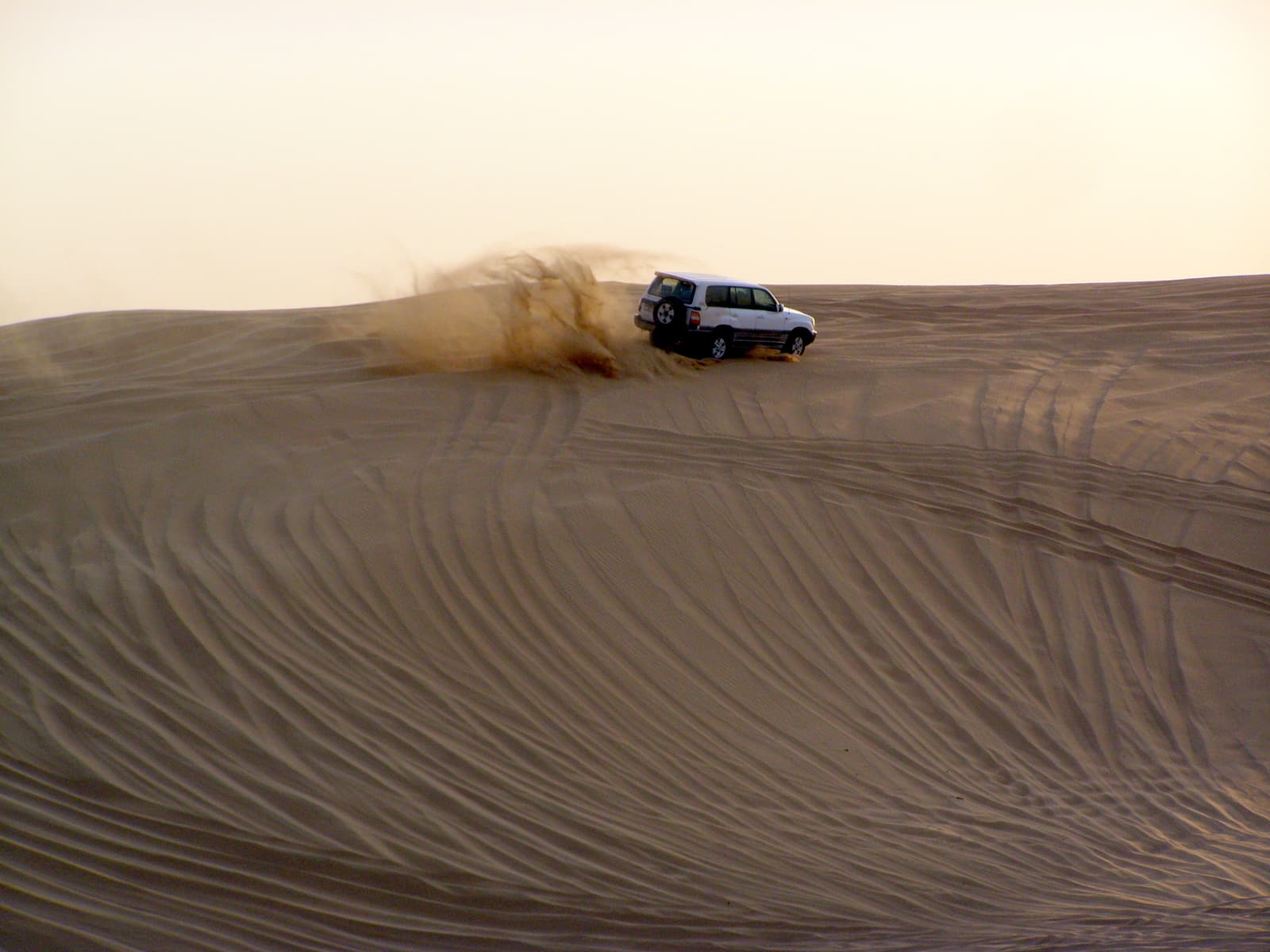
Most people step out of the 4x4 grinning. A few step out green, and a small number should never have got in. Dune bashing is a deliberately rough ride — steep climbs, sideways slides and sudden drops — and operators’ own terms exclude several groups of people. This page is general guidance, not medical advice; if in doubt, ask your doctor and tell the operator before you book.
Who should not do the dune drive
- Pregnant travellers — at any stage. Operators will not knowingly take pregnant guests dune bashing.
- Anyone with back or neck problems, including slipped discs, sciatica, previous spinal surgery or whiplash.
- People with heart conditions, uncontrolled high blood pressure, epilepsy or a recent operation or fracture.
- Infants and toddlers. Minimum ages are set by each operator and commonly fall at around three years for the dune drive; a child must be big enough to be belted in properly.
- Frail older travellers and anyone with osteoporosis.
- Anyone who is unwell, hung-over or prone to severe motion sickness.
Options at a glance
| If you are… | Avoid | Choose instead |
|---|---|---|
| Pregnant | Dune bashing, quad bikes, camel rides, sandboarding | Direct transfer to the camp for dinner; Al Wathba fossil dunes; a desert resort stay |
| Living with back or neck problems | Dune bashing, quad bikes, dune buggies | Camp-only evening; Al Ain day tour; desert resort |
| Travelling with a baby or toddler | Dune bashing; late-night returns | Private tour with a gentle track drive; morning visit to Al Wathba |
| Prone to motion sickness | Back-row seat; heavy meal beforehand | Front seat, a “soft” drive on request, a morning tour |
| Over 65 and fit | Nothing in particular — ask for a gentle drive | A standard safari, with a private vehicle if preferred |
| Nervous but curious | The back row | A private safari where you set the pace |
Can I still go to the camp?
Usually, yes. Most camps can be reached by a firm track without crossing dunes, and many operators will take guests who cannot dune-bash straight to the camp to wait for the rest of the group, or run a separate gentle vehicle. Arrange this before you book — message the operator through GetYourGuide — rather than on the day. A private vehicle makes it simple: the driver does exactly as much, or as little, as you ask.
Motion sickness: how to avoid it
- Eat lightly two to three hours before. Neither a full stomach nor an empty one. Skip greasy food and alcohol.
- Ask for the front passenger seat or the middle row by a window. The back row moves the most.
- Look out at the horizon, not at your phone or camera screen.
- Consider medication. Travel-sickness tablets work best taken before the drive, not once you feel ill; ask a pharmacist which suits you, and note that some cause drowsiness.
- Tell the driver early. A good driver will ease off, take a gentler line or stop. There is no prize for suffering in silence.
- Choose morning. Cooler air and an empty-ish stomach help; so does a shorter drive.
Is dune bashing safe for everyone else?
Serious accidents are uncommon, but they happen, and nearly always involve one of three things: no seat belt, an unlicensed or reckless driver, or a vehicle without a roll cage. So:
- Wear the seat belt for the whole drive, and make sure children do.
- Use a licensed operator with roll-caged 4x4s driving in convoy — see how to choose an operator.
- Keep arms and heads inside, and secure phones, cameras and bottles.
- If the driving frightens you, say so. You are the customer.
Quad bikes, buggies and sandboards
Statistically, the quad bike is the riskiest thing at the camp, not the 4x4. Wear the helmet, stay inside the marked area, keep your speed down on crests and never carry a small child on your lap. Many travel-insurance policies exclude quad biking unless you add cover. Sandboarding falls are soft but can twist a knee or wrist; start sitting down if you are unsure.
Camels and children
The lurch as a camel stands and kneels surprises everybody: lean back as it rises, hold the saddle frame, and keep small children with an adult. Camel rides are not advised in pregnancy.
Heat, sun and water
From May to September heat is the main hazard. Drink water steadily, wear a hat and sunscreen, and watch children and older travellers for headache, dizziness or unusual tiredness — get into the air-conditioned vehicle and tell the guide if these appear. Hot sand can burn bare feet by day in summer. See the best time to go.
Gentle alternatives
- Al Wathba fossil dunes and salt lake — a flat walk among extraordinary formations.
- Al Ain Oasis and Jebel Hafeet — shaded palm groves and a mountain road.
- Abu Dhabi Falcon Hospital — desert heritage, indoors.
- A night at a desert resort, where you can watch the dunes from the terrace.
In an emergency
Tell your guide at once — drivers carry first-aid kits and radios. The UAE emergency numbers are 999 for police and 998 for an ambulance. Carry your travel-insurance details and any regular medication with you rather than leaving them at the hotel.